Atlantic City Action Report (ACAR)
Do Atlantic City Casinos Give High Rollers Money Back When They Lose?
Leaked Las Vegas casino documents reveal loss rebates as high as 23%. Atlantic City has its own remarkable history with these deals, including a blackjack player who won more than $15 million. Here’s what AC players should know.

Most Atlantic City casino players know how the rewards system works. Play enough, and you might get a free room, a dining credit or some free play for your next visit. If you’re a regular at Borgata, Hard Rock, Ocean or one of the Caesars properties, you probably have a pretty good idea of what your casino is willing to give you.
But imagine something different. What if you walked into a casino, lost $100,000 playing blackjack and the casino handed you $20,000 back? Not a future promotional offer or a complimentary suite, but an actual reduction in what you lost.
It sounds like a pretty generous deal, and it is. But arrangements like this exist in the high-stakes gambling world. They’re called discounts on loss, or DOLs, and a recent report out of Las Vegas offers a fascinating look at how much money casinos may be willing to return to their biggest players.
Atlantic City has a history with these arrangements, too. In fact, one of the most famous examples of a player turning a casino’s generosity against it happened right here on the Boardwalk.
A leaked Las Vegas document reveals the numbers
On November 15, 2026, Scott Roeben of Vital Vegas, published on Casino.org, reported obtaining an internal casino document detailing loss rebates for high rollers. The document, titled “Airfare/Discount Policy,” outlined a sliding scale of rebates tied to the amount a player loses.
According to Roeben’s reporting, the discounts begin at 3% for a $25,000 loss and climb to 23% for a $2 million loss. At the highest level, that means a player who loses $2 million could receive $460,000 back, reducing the actual loss to $1.54 million.
That’s still a painful gambling trip by anyone’s standards, but nearly half a million dollars returned is certainly better than nothing.
The document reflects a reported Las Vegas casino policy, not an Atlantic City offer. Roeben also noted that the published document was recreated with identifying details removed to protect the source. The actual terms available to individual players may differ.
Original reporting: Scott Roeben, Vital Vegas / Casino.org, November 15, 2026.
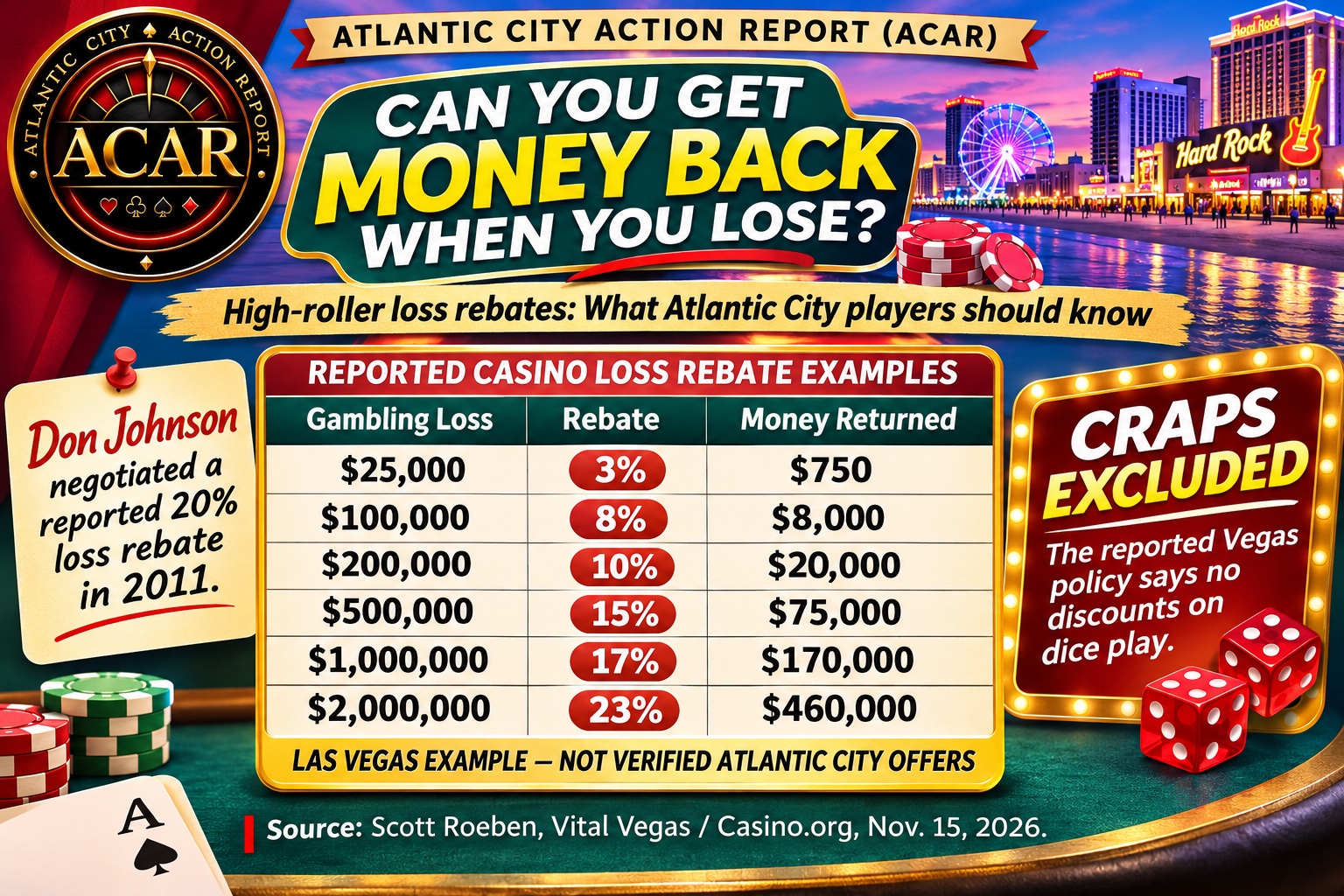
Reported Las Vegas rebates. Not verified Atlantic City offers.
What makes these arrangements particularly interesting is that they aren’t ordinary casino promotions. High rollers can negotiate them before playing, often as part of a larger package that includes accommodations, transportation and other benefits.
If the player loses, the casino absorbs an agreed portion of that loss. If the player wins, the player generally keeps the winnings. The casino is betting that its mathematical advantage, combined with enough gambling activity, will make the relationship profitable over time.
Of course, that doesn’t always work out as planned.
Atlantic City’s $15 million lesson: Don Johnson
Atlantic City has already experienced what happens when a player negotiates a deal that turns out to be a little too good.
Between late 2010 and April 2011, blackjack player Don Johnson won approximately $15 million from three Atlantic City casinos. He took roughly $6 million from Tropicana, $5 million from Borgata and $4 million from Caesars, according to reporting by ABC News.
Johnson wasn’t counting cards or using some secret blackjack system. He was an experienced gambler who understood the mathematics of the game and, perhaps more importantly, the value of negotiating with casinos that wanted his business.
At the time, Atlantic City casinos were competing aggressively for high-end customers following the financial crisis. Johnson used that competition to negotiate unusually favorable playing conditions, including a reported 20% discount on qualifying losses.
Under his Tropicana arrangement, the discount reportedly became available when losses reached $500,000. If Johnson lost that amount and stopped playing under the agreed terms, he would receive $100,000 back, leaving him with a net loss of $400,000.
But if he won $500,000, he kept the full winnings.
Johnson also negotiated blackjack rules that reduced the house advantage. Reports described a hand-shuffled six-deck game, favorable doubling and splitting rules, and a dealer who stood on soft 17. Those conditions brought the underlying game much closer to an even proposition before the loss rebate was considered.
The rebate was what made the arrangement especially powerful. Johnson could limit the damage from a qualifying losing session while retaining the full benefit of a winning one. That doesn’t guarantee a profit on any particular visit, but the combination of favorable rules and a carefully structured rebate can change the mathematics substantially.
His run became one of the most remarkable gambling stories in Atlantic City history. The casinos eventually stopped offering him those terms, but not before he had walked away with millions.
It’s worth remembering that Johnson wasn’t simply an average player who asked nicely for a better deal. He was wagering as much as $100,000 per hand and reportedly putting up $1 million in front money. Those were extraordinary circumstances, even by high-roller standards.
Still, his story illustrates something most casino visitors never consider. Sometimes the most valuable advantage isn’t found on the felt. It’s negotiated before the first card is dealt.
There’s a catch for craps players
One of the more interesting details in the Vital Vegas report is that the disclosed casino policy specifically excluded dice games from loss rebates.
The document stated, “No discounts in dice play.” It also indicated that when a player participated in multiple games, craps losses would be excluded from the rebate calculation.
That’s a significant distinction. Imagine a high roller who spends part of a trip playing blackjack and another part playing craps. Under the reported policy, the player might qualify for a rebate on eligible blackjack losses while receiving nothing back for losses at the craps table.
Why would a casino make that distinction?
The answer comes down to the mathematics of the game. Craps offers some relatively low-house-edge wagers, particularly compared with many slot machines and certain other table games. The Pass Line has a house edge of approximately 1.41%, while placing the 6 or 8 carries an edge of about 1.52%. Taking odds behind a Pass Line bet carries no house advantage at all.
That last point matters. A player betting $25 on the Pass Line with $125 in odds has $150 at risk, but the casino’s expected profit comes from the $25 flat bet, not the odds portion.
If a casino also agreed to return a substantial percentage of that player’s losses, it could create an unattractive financial arrangement for the house. Depending on the rebate structure and the player’s betting pattern, the casino could be giving away more value than it expects to earn.
That helps explain why the reported Las Vegas policy excludes craps.
But there’s an important distinction for Atlantic City players. ACAR has not verified that Atlantic City casinos universally exclude craps from privately negotiated loss rebates. The restriction described by Vital Vegas applies to the reported Las Vegas policy.
And being excluded from a loss rebate doesn’t mean craps players are excluded from regular casino comps.
What this means if you play craps in Atlantic City
Let’s bring this down to a more familiar level. Suppose you’re playing at a $25 craps table at Borgata or Hard Rock. You make a $25 Pass Line bet, take odds and perhaps place the 6 and 8. You might have $150 or more working on the table, but that doesn’t necessarily mean the casino rates you as a $150 player.
Casinos evaluate craps action differently depending on the wagers involved and their internal rating policies. Odds bets, for example, may receive little or no theoretical credit because they carry no house advantage. Other bets may contribute more toward your rating even when the total amount wagered is smaller.
Consider two players spending four hours at the same table. One makes relatively modest flat bets with substantial odds behind them. The other consistently has $110 working across several place bets. Both may have meaningful amounts at risk, but their theoretical value to the casino can be quite different.
That’s why understanding your average rated bet matters. If you’re a regular craps player in Atlantic City, it doesn’t hurt to ask the pit supervisor or your host what average wager is being recorded for your play.
You may discover that the casino sees your action differently from the way you see it.
None of this means you should abandon low-house-edge wagers to earn better comps. In fact, that could easily cost you more than the additional rewards are worth. But understanding how your play is evaluated can help explain why certain offers appear in your account and others don’t.
Why would a casino give back so much money?
To understand why a casino might offer a six-figure loss rebate, it helps to understand how casinos evaluate their customers.
Most players naturally think about gambling in terms of actual wins and losses. If you lose $5,000 during a weekend, that’s a significant loss to you. But the casino doesn’t necessarily consider that $5,000 to be your long-term value as a customer.
Instead, casinos commonly use something called theoretical loss, or theo. This estimates how much the casino expects to earn from your gambling activity based on the game, average wager, pace of play and time spent playing.
Consider a blackjack player wagering $100 per hand for four hours. At an estimated 60 hands per hour and a 1% house advantage, that player generates approximately $240 in theoretical casino revenue.
The player might actually win $2,000 or lose $3,000 during those four hours. Either result is possible, but the underlying theoretical value remains approximately $240 under those assumptions.
Now imagine a high roller betting $5,000 per hand for six hours. Using the same assumptions, that player generates approximately $18,000 in theoretical casino revenue during the session. Over multiple trips, that expected revenue can become substantial.
This is why casinos are willing to spend money attracting and retaining high-value customers. Complimentary suites, meals, transportation and even negotiated rebates can be part of the cost of doing business.
It also explains why a player who loses $50,000 in ten minutes isn’t necessarily more valuable than someone who consistently plays for hours. Casinos generally want enough action for their mathematical advantage to have time to work.
A large loss rebate may look generous, but the casino is evaluating the entire relationship, not simply handing out money because someone had a bad night.
Can you negotiate a loss rebate in Atlantic City today?
The Don Johnson story proves that Atlantic City casinos have offered these arrangements in the past. What it doesn’t establish is whether the same types of agreements are available today or what terms individual properties might be willing to negotiate.
As of November 2026, ACAR has not independently verified a current loss-rebate schedule at Borgata, Hard Rock, Ocean, Caesars, Tropicana or any other Atlantic City casino.
That doesn’t necessarily mean private arrangements don’t exist. High-end casino agreements are often negotiated directly with executive hosts and aren’t advertised to the general public.
For someone gambling at sufficiently high stakes, the sensible approach would be to discuss the terms with a casino executive host before playing. The important questions go well beyond the rebate percentage. Does the discount apply to daily losses or the entire trip? Are winnings from other games offset against losses? Is there a minimum amount of action required? Does the rebate come back as cash, chips or promotional credits?
And, as the Vital Vegas document demonstrates, which games qualify can make an enormous difference.
A 20% rebate sounds attractive until you discover that the game you actually play isn’t eligible.
What can the average Atlantic City player learn from this?
Most of us aren’t walking into Ocean or Borgata with a million dollars in front money. We’re playing within a much smaller budget, hoping to enjoy ourselves and maybe earn a decent offer for the next visit.
But the same basic principle applies at almost every level of casino play. The casino assigns a value to your business, and that value influences the benefits you’re offered.
If you’re a regular player at one property, it’s worth understanding how your play is being rated. Someone who consistently plays $50 blackjack for several hours may generate more theoretical value than another player who makes a handful of large bets and leaves. The actual result of either session doesn’t necessarily tell the casino much about what the player is worth over time.
It’s also worth having a conversation with a host if you play regularly. You may already qualify for additional dining credit, a room or another discretionary benefit that isn’t automatically displayed in your account. There’s no guarantee, but asking about benefits based on your existing play is perfectly reasonable.
The key is to evaluate those offers realistically. A complimentary room is valuable if you were planning to stay overnight anyway. A dining credit is useful if it covers something you would otherwise purchase. But neither is worth increasing your gambling losses just to qualify.
That’s where understanding theo becomes useful. It helps you see the casino’s side of the relationship without forgetting that you’re the one putting real money at risk.
What about the rest of us?
Most of us walking into Borgata, Hard Rock, Ocean or any other Atlantic City casino aren’t playing at a level where we can negotiate getting 20% of our losses back. We’re hoping for a good session, maybe a nice dinner on the casino’s dime, and hopefully a room offer for our next visit.
But it’s interesting to see just how differently the casino business works when the stakes get high enough. The same casino that might offer an average player $25 in free play could be negotiating a six-figure loss rebate with someone upstairs in the high-limit room.
And here’s something worth thinking about. If you ever found yourself playing at a level where a casino offered to return 15% or 20% of your losses, would you take the deal? It sounds attractive, but you’re still putting a substantial amount of money at risk. A rebate might soften a bad night, but it doesn’t automatically make the underlying game a good bet.
For the rest of us, there’s a more practical lesson. Know how your play is being rated, understand what your casino offers are actually worth, and don’t be afraid to ask your host whether there’s something more available based on the play you’re already giving them.
We’re curious what ACAR readers think. Have you ever heard of a loss-rebate arrangement in Atlantic City? Have you negotiated something beyond the usual room, food or free-play offers? And if you were offered a discount on your losses, would it change how you play?
Let us know what you think. We’d love to hear from Atlantic City players on this one.
Sources and reporting
Original reporting: Scott Roeben, Vital Vegas, Casino.org, November 15, 2026. Leaked: Casino Loss Rebates for High Rollers Revealed.
Atlantic City history: Alan Farnham and Susanna Kim, ABC News, March 21, 2012. Blackjack Player Who Won $15 Million From 3 Casinos Reveals How.
Additional historical reporting: Henry Tamburin, Casino Player Magazine, January 10, 2017. At Their Own Game.
The rebate schedule was reported by Vital Vegas and relates to a Las Vegas casino. ACAR has not independently verified current Atlantic City loss-rebate offers.